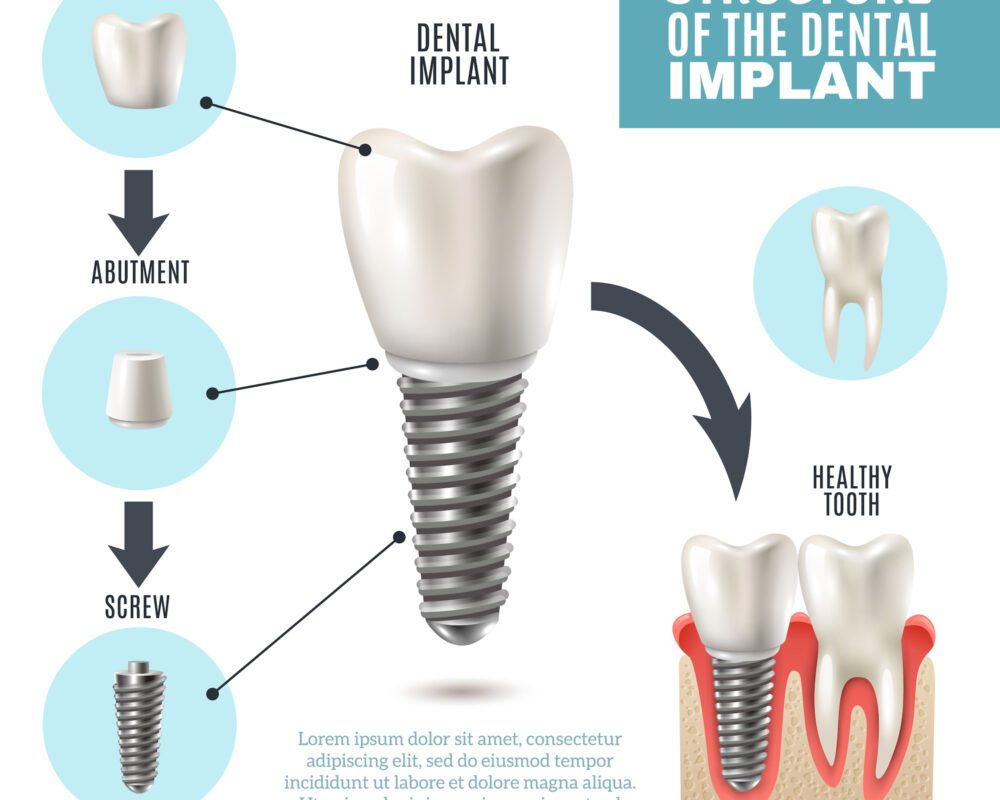
The dental implant procedure replaces a missing tooth with a small titanium post placed in the jawbone, which then supports a custom crown. Most single implants are completed in two to three main appointments over around three to four months, with the surgery itself carried out under local anaesthetic.
Below, Dr Sahil Patel, who leads our dental implants London treatment, explains each step in plain English, from your first scan to your final crown, along with what recovery really feels like and how to look after your implant so it lasts.
The Dental Implant Procedure at a Glance
| Stage | What happens | Typical timing |
|---|---|---|
| 1. Consultation and 3D scan | Examination, photographs, CBCT scan, treatment plan and quote | Week 0 |
| 2. Preparatory treatment (if needed) | Extraction, gum treatment or bone graft | Varies; grafting can add several months |
| 3. Implant placement | Implant placed under local anaesthetic | Around 75 minutes per implant |
| 4. Healing (osseointegration) | Implant fuses with the bone | Around 12 weeks |
| 5. Final connection and crown | Digital or analogue impressions, then crown fitted | Around 3 to 4 months after placement |
Step 1: Consultation and 3D CBCT Scan
Every implant starts with a detailed consultation. Dr Patel examines your teeth and gums, discusses your medical history and takes a 3D CBCT scan. The scan shows the height, width and quality of your jawbone and the position of nerves and sinuses, so the implant can be planned precisely in 3D before any treatment begins.
You then receive a written plan and fixed quote, with time to ask questions. The consultation and scan are included in our single implant price.
Step 2: Preparing the Site
Some patients need treatment before the implant can be placed:
- Tooth extraction: if the tooth is still present, it is removed. In suitable cases the implant can be placed at the same visit, known as same day dental implants.
- Gum treatment: active gum disease must be treated first. Read more about dental implants with gum disease.
- Bone grafting: if there is not enough bone, a bone graft rebuilds the area, either at the same time as the implant or beforehand.
Step 3: Implant Placement Surgery
On the day, the area is numbed with local anaesthetic. A small opening is made in the gum, a precise space is prepared in the bone, and the implant is placed. The gum is then closed around it or a small healing cap is left visible. Sedation is available for nervous patients through Dr Damien Reilly, a Consultant in Special Care Dentistry.
We use Straumann Reference and Southern Implants systems, chosen for their long clinical track records. See our dental implant brands guide for more detail.
Nervous about implant surgery?
You are not alone. At your consultation Dr Patel will walk you through each step, and sedation is available through Dr Damien Reilly if you would feel more comfortable.
Is dental implant surgery minor or major surgery?
Placing a single implant is a minor oral surgical procedure carried out in the dental chair under local anaesthetic. You go home the same day. Full arch treatment involving several implants is a longer procedure, but is still normally carried out without a hospital stay.
How long does it take to put in an implant?
A single straightforward implant usually takes around 75 minutes, including time for the anaesthetic. Several implants or full arch cases take longer.
Step 4: Healing and Osseointegration
Over the next few months the bone grows onto the implant surface and locks it in place. This is called osseointegration and usually takes around 12 weeks, sometimes longer in the upper jaw or where bone has been grafted. You will not be left with a visible gap during this time: we can provide a temporary tooth using a bridge, a removable plate or a fixed implant temporary.
Step 5: Abutment and Final Crown
Once the implant is stable, a custom abutment (the connection) is attached and digital impressions are taken. Your ceramic crown is made to match the shape and shade of your natural teeth, then fitted, usually around three to four months after implant placement.
How Long Does the Whole Process Take?
- Straightforward single implant: around three to four months from placement to final crown
- Implant placed at the same visit as an extraction: similar, as the healing periods overlap
- With a separate bone graft first: often nine months or more
- Full arch with same day teeth: fixed temporary teeth on the day, final bridge after a few months
Every case is different, and your plan will give you a timeline specific to you.
Does a Dental Implant Hurt?
The procedure itself should not hurt, because the area is fully numbed. Most people say they feel pressure and vibration rather than pain. Many patients tell us the extraction or the first few days afterwards are more uncomfortable than the implant placement.
Once the anaesthetic wears off, expect some tenderness, swelling and possibly mild bruising. This usually peaks around two to three days after surgery and then steadily improves. Painkillers such as ibuprofen and paracetamol are effective, and if you need anything stronger we will provide it. Contact us if pain is getting worse rather than better, or if you have a fever or bleeding that will not stop.
Dental Implant Recovery: Day by Day
The first 24 hours
Some minor oozing of blood is normal. Rest, keep your head raised and do not brush the implant site for 7 days. Avoid hot drinks, rinsing, heavy exercise, smoking and alcohol.
Days 2 to 3
Swelling is usually at its most noticeable. Stick to soft, cool or lukewarm foods and begin gentle mouth rinsing when advised.
Days 4 to 14
Swelling and tenderness fade. Most people return to desk work within a day or two of surgery, and many do not need to take any time off.
Weeks 2 to 12
Stitches are removed after around 3 weeks. The gum looks healed, but the bone is still integrating with the implant, so keep avoiding hard or chewy food on that side until we confirm the implant is stable.
Dental Implant Aftercare
After surgery
- Do not rinse vigorously or spit for the first 24 hours
- Avoid smoking and vaping, as both slow healing and raise the risk of failure
- Avoid alcohol and strenuous exercise for the first few days
- Eat soft foods and chew away from the site
- Brush your other teeth normally, but do not clean around the implant for 7 days
- Take any medication as prescribed
Long term
- Brush twice a day and clean between teeth and around the implant with interdental brushes or floss
- Keep your annual dental check-ups and twice-yearly hygiene appointments
- Wear a night guard if you grind your teeth
- Do not use your implant to open packets or bite very hard objects
When Can I Eat Normally After a Dental Implant?
For the first few days, stick to soft foods such as soup, yoghurt, eggs and mashed vegetables. Most people gradually return to a normal diet over the following weeks, but you should avoid biting hard foods directly on the implant until your final crown is fitted. Once it is, you can usually eat almost anything, including biting into an apple.
What Can Slow Down Healing?
- Smoking and vaping
- Poorly controlled diabetes and some other medical conditions
- Certain medications, such as current or past use of bisphosphonates for cancer or osteoporosis
- Untreated gum disease
- Heavy grinding or clenching
- Not following aftercare advice
Risks of Dental Implant Treatment
Dental implants have a high success rate, but like any surgical procedure they carry some risk. These include infection, bleeding, swelling, the implant failing to integrate, and rarely nerve or sinus involvement. Careful 3D planning reduces these risks, and Dr Patel will explain what applies to you at your consultation.
Frequently Asked Questions
How many days should I rest after a dental implant?
Most people need a day or two of rest after a single implant and can return to desk work soon after. After several implants or full arch treatment, plan for a few more days.
What is the most painful part of getting a dental implant?
For most patients, the most uncomfortable part is the first two or three days of recovery, not the procedure itself, which is carried out under local anaesthetic.
Do you have no teeth while waiting for implants?
No. We can provide a temporary tooth while your implant heals, and in suitable cases a fixed temporary crown can be fitted on the day of surgery.
Is there an age limit for dental implants?
There is no upper age limit. What matters is your general health and bone quality. Implants are not usually placed until the jaw has finished growing in early adulthood.
How much does a dental implant cost?
A single implant at Marylebone Smile Clinic starts from £3,495, including consultation, 3D CBCT scan, implant, custom abutment and ceramic crown, with a 5-year guarantee. See our dental implant cost guide for full details.
Get a clear plan and timeline
Your consultation includes a 3D CBCT scan, a written treatment plan and a fixed quote.

Lead implant dentist at Marylebone Smile Clinic and an Accredited member of the British Academy of Cosmetic Dentistry. Sahil plans and places implants, bone grafts and gum grafts at our Harley Street clinic.
GDC number: 258353.